
In order to produce the best possible product, ProCurve Glass Design, Inc. requires that our customers provide us with a template. To better serve our customers we have put together the following information that will help answer frequently asked questions on the subject of template making.
What is a template?
- A sturdy fixture that replicates the glass contour & size
- Template surface is the contrasting surface to ProCurve’s tooling
- Template surface must be rigid and well supported
- Measurements must be exact
- Templates must not have bowing / warping in the central area of the bend
Template Terminology
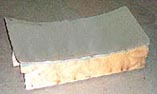 Concave Surface Template = used for convex glass bend
A concave surface template represents the inside glass surface against frame support. The template is used to fabricate tooling where glass is bent over male mold surface
If a concave surface template is used to represent an outside glass surface, this form of template is also used to check the glass for fit after full fabrication. (THIS IS BEST )
Example: This form of template is often used with tighter radii and irregularly shaped glass (i.e., corner lites and conical shapes)
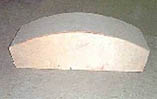 Convex Surface Template = used for concave glass bend
A convex surface template represents the outside glass surface of a windshield. With this type of template, the glass is bent into our concave mold
This form of template is often used with large, shallow bends (i.e., side windows and front center windshields)
If a convex surface template is used to represent the inside glass surface or 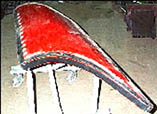 inside frame surface, this type of template can be used to check the glass for fit after fabrication. (This type of template is best for tight radius bends that have tangents or are conical shapes. MUST ONLY BE USED TO REPRESENT FRAME SURFACE. )
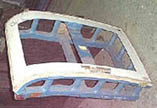 Cylindrical Shape = a convex or concave template
A curve in which the top and bottom radii are the same. A template created from either the inside or outside glass surface is acceptable to produce a final product
Typically tighter bends are concave – inside surface
Loose radius are convex – inside surface
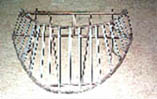 Conical Shape = a concave surface template only
A curve in which the top and bottom radii are different. Only a template of inside (concave fixture) glass surface will work to produce a final product
Getting Started – General Guidelines
Use only durable materials such as hardboard, fiberglass, and aquaplus pvc foam over Formica, to create sturdy templates
Reinforce your template to maintain accuracy and stiffness to prevent twist problem.
To insure that the perimeter shows the correct shape, double check your work by placing the checking fixture into the opening (frame) where the glass will be installed. The center of the template must be free of bulges. Bulges will distort the contour of the perimeter
If the edge of the template exceeds the glass edge, indicate the final cut line
Suggested Preparation when Working with Existing Frames
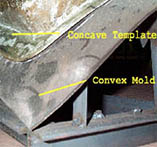 Match the template to the surface where the glass will ultimately be installed. Use the outside glass surface to construct a concave template surface
The template will be the “female” counterpart to our “male” tooling
To form the contour of the glass, place aquaplus pvc foam (4’ x 8’ sheet) over a supported Formica surface. This material is hot formed and needs to cool slowly or the shape will warp
To maintain stiffness and accuracy, use balsa core/fiberglass material with carbon fibers to stiffen the aquaplus pvc foam so that it is 1/2” thick
In place of fiberglass customers can use wood, aluminum or other rigid materials that will form a sturdy template
Trim the template to final glass size, or etch the desired glass edge into the surface (SEE BELOW)
Suggested Preparation when no frame exists – Fiberglass Hull Cut-out
Identify and mark the window location on the boat
After a rough opening has been cut into the hull, save the cut-out
Use the cut-out to produce a bending template of the glass surface
Add additional fiberglass and stiffeners to create an accurate perimeter dimension and contour shape. A smooth finish along the perimeter is important
If the glass has a shallow bend, such as windows on the side of a boat, make a bending
template to the outside window surface > (convex shape)
If the glass has a tight irregular shape and contour, such as pilot house windows, the template should represent the outside glass surface > (concave shape)
Finalizing the Template
Label all sides of the template (i.e. customer’s name, order#, port, starboard, deck level, superstructure, etc.)
Identify stencil location and blackout perimeter to the edge of vision area with lines on the template. Name the type, thickness and color of glass (light transmission if known)
Check all measurements three times to provide for gasket material, thickness of wet glazing, and expansion and contraction of materials
ProCurve Glass Design, Inc. takes digital pictures of all materials sent to us. If you also have access to a digital camera, supplementary photographs to illustrate additional details are helpful in the event that questions arise concerning glass size